Patients arrive with symptoms, not specialties. ScrubUp lets you study both ways: by the system you're revising, or by how the patient actually walks in.
429Conditions
220Presentations
7,038Questions at launch
Yesterday's mistake. Tomorrow's flashcard.
A nightly cloze deck built from your mistakes. Re-meets you exactly when you'd forget the answer.
Cards generated from your wrong answers, not a generic library.
Resurfaces at 1 day, 3 days, 8 days, 30 days. The forgetting curve, automated.
Ten minutes a day. Six reviews of each weak point by exam week.
Try one →
Try a cardCardiology · Day 1 of revision
In acute coronary syndrome, the first-line antiplatelet given on arrival is
type your answer
, followed by a second antiplatelet.
7 letters
How was that?
Logged.
More than a question bank.
Built for depth. Image-heavy by design. With a tutor in your pocket when you're stuck.
7,038
UKMLA questions
Arrange by specialty or presentation
1,000+
ECGs
1,000+
Chest X-rays
You learn better when you can see it.
Every clinical sign, every imaging study, every dermatology pattern is shown alongside the question. Doctor-curated, real clinical photography, with the same images available again in the companion textbook.
The research is consistent. Pairing images with text (dual coding) significantly improves recall compared with text alone, especially for visual diagnoses. ScrubUp is built around this finding from the ground up.
Built with the societies students already trust.
We work with medical student societies across the UK to build what students actually need.
16Partner societies
from
11UK medical schools
EUTOS
Edinburgh University Trauma & Orthopaedics SocietyEdinburgh
BRAIN
BrainstormEdinburgh
SCOPE
KCL SCOPEKing’s College London
LUSEMS
Leicester University Sports & Exercise Medicine SocietyLeicester
SGPS
University of Sunderland GP SocietySunderland
PAEDS
University of Southampton Paediatrics SocietySouthampton
EUTOS
Edinburgh University Trauma & Orthopaedics SocietyEdinburgh
BRAIN
BrainstormEdinburgh
SCOPE
KCL SCOPEKing’s College London
LUSEMS
Leicester University Sports & Exercise Medicine SocietyLeicester
SGPS
University of Sunderland GP SocietySunderland
PAEDS
University of Southampton Paediatrics SocietySouthampton
EUTOS
Edinburgh University Trauma & Orthopaedics SocietyEdinburgh
BRAIN
BrainstormEdinburgh
SCOPE
KCL SCOPEKing’s College London
LUSEMS
Leicester University Sports & Exercise Medicine SocietyLeicester
SGPS
University of Sunderland GP SocietySunderland
PAEDS
University of Southampton Paediatrics SocietySouthampton
EUTOS
Edinburgh University Trauma & Orthopaedics SocietyEdinburgh
BRAIN
BrainstormEdinburgh
SCOPE
KCL SCOPEKing’s College London
LUSEMS
Leicester University Sports & Exercise Medicine SocietyLeicester
SGPS
University of Sunderland GP SocietySunderland
PAEDS
University of Southampton Paediatrics SocietySouthampton
EUTOS
Edinburgh University Trauma & Orthopaedics SocietyEdinburgh
BRAIN
BrainstormEdinburgh
SCOPE
KCL SCOPEKing’s College London
LUSEMS
Leicester University Sports & Exercise Medicine SocietyLeicester
SGPS
University of Sunderland GP SocietySunderland
PAEDS
University of Southampton Paediatrics SocietySouthampton
EUTOS
Edinburgh University Trauma & Orthopaedics SocietyEdinburgh
BRAIN
BrainstormEdinburgh
SCOPE
KCL SCOPEKing’s College London
LUSEMS
Leicester University Sports & Exercise Medicine SocietyLeicester
SGPS
University of Sunderland GP SocietySunderland
PAEDS
University of Southampton Paediatrics SocietySouthampton
GUPRAS
Glasgow University Plastic, Reconstructive & Aesthetic Surgery SocietyGlasgow
MGPS
The Mackenzie General Practice SocietySt Andrews
MATS
Exeter Medics as Teachers SocietyExeter
MaxFax
University of Aberdeen Oral & Maxillofacial Surgery SocietyAberdeen
CPS
Chester Paediatrics SocietyChester
GUPRAS
Glasgow University Plastic, Reconstructive & Aesthetic Surgery SocietyGlasgow
MGPS
The Mackenzie General Practice SocietySt Andrews
MATS
Exeter Medics as Teachers SocietyExeter
MaxFax
University of Aberdeen Oral & Maxillofacial Surgery SocietyAberdeen
CPS
Chester Paediatrics SocietyChester
GUPRAS
Glasgow University Plastic, Reconstructive & Aesthetic Surgery SocietyGlasgow
MGPS
The Mackenzie General Practice SocietySt Andrews
MATS
Exeter Medics as Teachers SocietyExeter
MaxFax
University of Aberdeen Oral & Maxillofacial Surgery SocietyAberdeen
CPS
Chester Paediatrics SocietyChester
GUPRAS
Glasgow University Plastic, Reconstructive & Aesthetic Surgery SocietyGlasgow
MGPS
The Mackenzie General Practice SocietySt Andrews
MATS
Exeter Medics as Teachers SocietyExeter
MaxFax
University of Aberdeen Oral & Maxillofacial Surgery SocietyAberdeen
CPS
Chester Paediatrics SocietyChester
GUPRAS
Glasgow University Plastic, Reconstructive & Aesthetic Surgery SocietyGlasgow
MGPS
The Mackenzie General Practice SocietySt Andrews
MATS
Exeter Medics as Teachers SocietyExeter
MaxFax
University of Aberdeen Oral & Maxillofacial Surgery SocietyAberdeen
CPS
Chester Paediatrics SocietyChester
GUPRAS
Glasgow University Plastic, Reconstructive & Aesthetic Surgery SocietyGlasgow
MGPS
The Mackenzie General Practice SocietySt Andrews
MATS
Exeter Medics as Teachers SocietyExeter
MaxFax
University of Aberdeen Oral & Maxillofacial Surgery SocietyAberdeen
CPS
Chester Paediatrics SocietyChester
SAACC
University of St Andrews Acute & Critical Care SocietySt Andrews
EUVSS
Edinburgh University Vascular Surgery SocietyEdinburgh
MWPM
Manchester Widening Participation MedicsManchester
AOS
University of Aberdeen Ophthalmology SocietyAberdeen
ASMS
University of Aberdeen Aviation & Space Medicine SocietyAberdeen
SAACC
University of St Andrews Acute & Critical Care SocietySt Andrews
EUVSS
Edinburgh University Vascular Surgery SocietyEdinburgh
MWPM
Manchester Widening Participation MedicsManchester
AOS
University of Aberdeen Ophthalmology SocietyAberdeen
ASMS
University of Aberdeen Aviation & Space Medicine SocietyAberdeen
SAACC
University of St Andrews Acute & Critical Care SocietySt Andrews
EUVSS
Edinburgh University Vascular Surgery SocietyEdinburgh
MWPM
Manchester Widening Participation MedicsManchester
AOS
University of Aberdeen Ophthalmology SocietyAberdeen
ASMS
University of Aberdeen Aviation & Space Medicine SocietyAberdeen
SAACC
University of St Andrews Acute & Critical Care SocietySt Andrews
EUVSS
Edinburgh University Vascular Surgery SocietyEdinburgh
MWPM
Manchester Widening Participation MedicsManchester
AOS
University of Aberdeen Ophthalmology SocietyAberdeen
ASMS
University of Aberdeen Aviation & Space Medicine SocietyAberdeen
SAACC
University of St Andrews Acute & Critical Care SocietySt Andrews
EUVSS
Edinburgh University Vascular Surgery SocietyEdinburgh
MWPM
Manchester Widening Participation MedicsManchester
AOS
University of Aberdeen Ophthalmology SocietyAberdeen
ASMS
University of Aberdeen Aviation & Space Medicine SocietyAberdeen
SAACC
University of St Andrews Acute & Critical Care SocietySt Andrews
EUVSS
Edinburgh University Vascular Surgery SocietyEdinburgh
MWPM
Manchester Widening Participation MedicsManchester
AOS
University of Aberdeen Ophthalmology SocietyAberdeen
ASMS
University of Aberdeen Aviation & Space Medicine SocietyAberdeen
A 78-year-old man is brought to the emergency department after two episodes of sudden collapse without warning today. He is pale and lightheaded. His heart rate is 40 bpm and blood pressure 92/54 mmHg. His ECG is shown.
What does the ECG show?
Why this is wrong
First-degree AV block is a fixed, prolonged PR interval (over 200 ms) with every P wave followed by a QRS. Here many P waves are not followed by a QRS at all.
Why this is wrong
Mobitz I (Wenckebach) shows a PR interval that lengthens progressively until a P wave is dropped, then the cycle repeats. Here there is no consistent PR interval because the P waves and QRS complexes are unrelated.
Why this is wrong
Mobitz II has a constant PR interval in the conducted beats with occasional P waves suddenly not conducted. Here the PR interval varies randomly because no P waves are being conducted.
Correct
The P waves are regular at about 100 per minute and the QRS complexes are regular at about 40 per minute, but they bear no relationship to each other: complete AV dissociation. Collapse without warning (Stokes-Adams attacks), bradycardia and hypotension make this an emergency. Treat adverse features with IV atropine, then pacing if there is no response, and refer for a permanent pacemaker.
Why this is wrong
In sinus bradycardia every P wave is followed by a QRS with a constant PR interval, just at a slow rate. Here the atrial rate is faster than the ventricular rate.
Key learning point
In complete heart block the P waves and QRS complexes are completely unrelated, with a slow, regular escape rhythm. Treat instability with IV atropine then pacing, and arrange a permanent pacemaker.
A 67-year-old man presents with a 3-day history of productive cough, fever and right-sided pleuritic chest pain. He is alert and orientated. Temperature 38.6°C, respiratory rate 24/min, heart rate 102 bpm, blood pressure 128/76 mmHg, SpO₂ 95% on air. Urea is 6.1 mmol/L. He has no allergies. His chest X-ray is shown.
What is the most appropriate management?
Correct
His CURB-65 score is 1: he scores only for age (65 or over). He is not confused, his urea is below 7 mmol/L, his respiratory rate is below 30 and his blood pressure is normal. That is low-severity community-acquired pneumonia, so NICE recommends oral amoxicillin 500 mg three times a day for 5 days, with home treatment if there are no other concerns and clear safety-netting advice.
Why this is wrong
Dual IV antibiotics are for high-severity pneumonia (CURB-65 of 3 or more). With a score of 1 he does not need IV treatment or, on these figures, admission.
Why this is wrong
Clarithromycin (or doxycycline) is the alternative for low-severity pneumonia when the patient is allergic to penicillin. He has no allergies, so amoxicillin is first line.
Why this is wrong
Antibiotics should start as soon as pneumonia is diagnosed, ideally within 4 hours of presentation. A follow-up X-ray is only offered at around 6 weeks if symptoms persist or there is a higher risk of underlying malignancy, such as in smokers over 50.
Why this is wrong
Fever, focal signs and lobar consolidation on the X-ray point to bacterial community-acquired pneumonia, which needs antibiotics.
Key learning point
Score community-acquired pneumonia with CURB-65 (Confusion, Urea >7 mmol/L, RR ≥30, BP <90/≤60, age ≥65). A score of 0–1 is low severity and is treated at home with 5 days of oral amoxicillin.
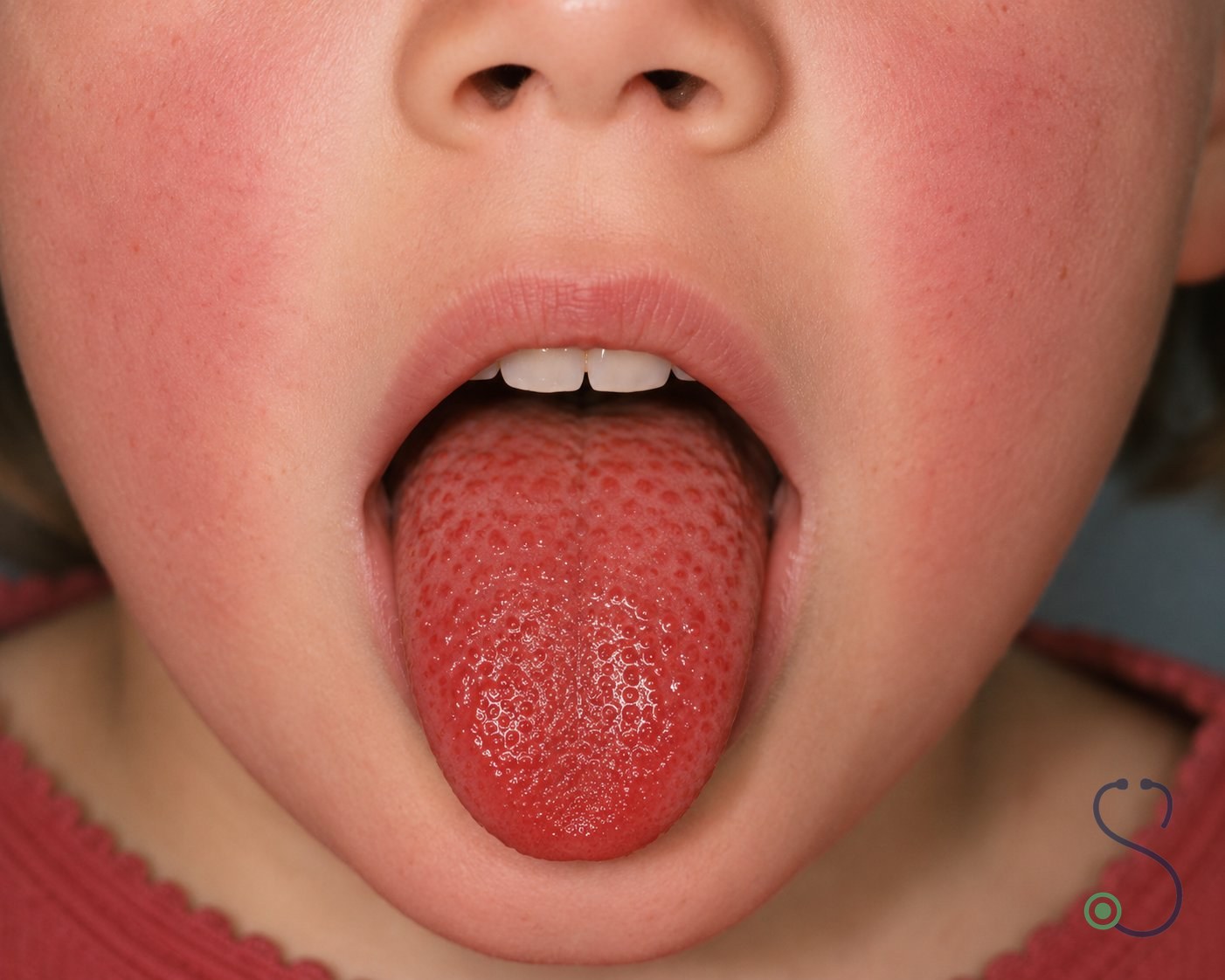
A 6-year-old presents with a 3-day history of fever, sore throat, and a sandpaper-like rash that started on the trunk. The cheeks are flushed with a pale ring around the mouth. The tongue appears as shown.
What is the most likely causative organism?
Why this is wrong
Staph aureus can cause toxic shock syndrome with strawberry tongue and rash, but the clinical picture there is shock and multi-organ involvement, not the classic scarlet fever syndrome described here.
Why this is wrong
EBV causes glandular fever. Features are exudative tonsillitis, posterior cervical lymphadenopathy, splenomegaly, and a rash if amoxicillin is given. No strawberry tongue or sandpaper rash.
Correct
This is scarlet fever, caused by Group A Strep exotoxin. The classic picture is sore throat plus sandpaper rash plus strawberry tongue plus circumoral pallor plus Pastia's lines. Treatment is 10 days of phenoxymethylpenicillin. Notifiable in the UK.
Why this is wrong
Measles presents with the 3 C's (cough, coryza, conjunctivitis), Koplik spots on buccal mucosa, then a head-to-toe maculopapular rash. Different oral sign entirely.
Why this is wrong
Parvovirus B19 causes slapped cheek syndrome: bright red cheeks followed by a lacy, reticular rash on the limbs. Fever is usually mild, and there is no sore throat, strawberry tongue or sandpaper rash.
Key learning point
Sandpaper rash, strawberry tongue and circumoral pallor mean scarlet fever from Group A Strep. Treat with 10 days of phenoxymethylpenicillin and notify public health.
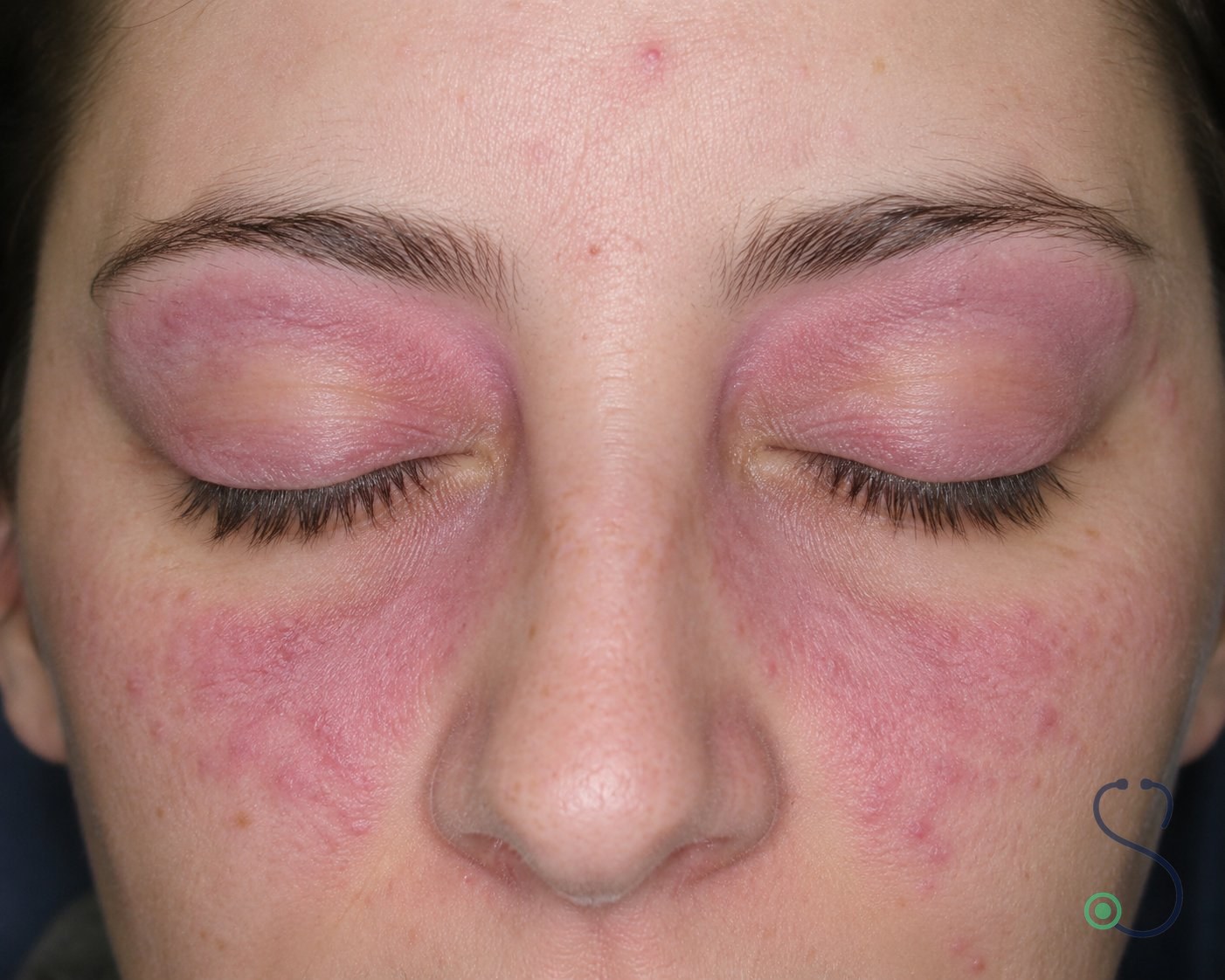
A 52-year-old woman presents with proximal muscle weakness, difficulty climbing stairs, and the facial appearance shown. Examination reveals violaceous plaques over the MCP and PIP joints of her hands.
Which antibody is most likely to be positive?
Why this is wrong
Anti-CCP is highly specific for rheumatoid arthritis, not myositis. RA affects MCPs and PIPs but causes synovitis with ulnar deviation, not violaceous plaques.
Why this is wrong
Anti-dsDNA is highly specific for SLE and correlates with disease activity (especially lupus nephritis). The clinical picture here is myositis, not lupus.
Why this is wrong
Anti-Ro is associated with Sjögren's syndrome and neonatal lupus. Sometimes seen in SLE but not the most likely antibody in dermatomyositis.
Why this is wrong
Anti-centromere antibodies point to limited cutaneous systemic sclerosis (CREST: calcinosis, Raynaud’s, oesophageal dysmotility, sclerodactyly, telangiectasia). It does not cause a heliotrope rash or proximal myositis.
Correct
This is dermatomyositis. The heliotrope rash plus Gottron's papules plus proximal weakness is classic. Anti-Jo-1 is the most likely specific antibody, associated with anti-synthetase syndrome (myositis plus ILD plus polyarthritis plus mechanic's hands). Always screen for underlying malignancy in patients over 40.
Key learning point
Heliotrope rash, Gottron’s papules and proximal weakness mean dermatomyositis, classically with anti-Jo-1 antibodies. Always screen for an underlying malignancy.
A 72-year-old woman presents with two days of palpitations and mild breathlessness. She has hypertension and type 2 diabetes. She is alert, with a blood pressure of 134/80 mmHg and no chest pain. Her ECG is shown.
What is the most appropriate first-line drug to control her heart rate?
Why this is wrong
Amiodarone is used for rhythm control or in haemodynamic instability and heart failure, not as first-line rate control in a stable patient. It also has significant long-term toxicity (thyroid, lung, liver).
Correct
The ECG shows atrial fibrillation: an irregularly irregular rhythm with no P waves, at about 120 bpm. She is haemodynamically stable, so NICE recommends rate control first, with a standard beta-blocker such as bisoprolol (or a rate-limiting calcium channel blocker such as diltiazem). Assess stroke risk with CHA₂DS₂-VASc and bleeding risk before anticoagulating.
Why this is wrong
Digoxin is only considered as monotherapy in people with non-paroxysmal AF who are sedentary. It controls the rate at rest but not on exertion, so it is not first line for most patients.
Why this is wrong
Adenosine is used to terminate re-entrant SVTs. In AF it only causes brief AV block and does not control the rate.
Why this is wrong
Flecainide is a rhythm-control drug (pharmacological cardioversion or pill-in-the-pocket). It is not a rate-control drug and is contraindicated in structural or ischaemic heart disease.
Key learning point
An irregularly irregular rhythm with no P waves is atrial fibrillation. In a stable patient, start rate control with a beta-blocker or rate-limiting calcium channel blocker, and use CHA₂DS₂-VASc to guide anticoagulation.
Dr Scrub is the chat layer built into ScrubUp. Got a question wrong? Ask why. Disagree with the explanation? Push back. Want a different worked example? Just say so.
Available at 2am, never tired, knows the guidelines.
Launching with ScrubUp · 2026
Beep boop. Still in training. See you at launch.
Dr Scrub
AI Tutor · Always online
Recognised by
Doctor-grade product. Student-friendly pricing.
Monthly
£8/ month
Cancel anytime. Full access.
Full question bank
AI tutor feedback
Personalised daily deck
Dr Scrub chat (when launched)
Best value
Annual
£24.99/ year
Same access, works out at £2.08 a month.
Everything in Monthly
Priority access to new content
OSCE module (when launched)
Help us build the question bank you wish you'd had.
We're recruiting at least one ScrubUp ambassador at every UK medical school. You'll help shape the product before it launches, get your year group ready for finals, and earn from every subscription you bring in.
Free Premium for the duration of the programme
A direct line to the founding team
Pre-launch access to new features
Your own discount code, earning you 10% of every subscription it brings in
Something worth writing about on your CV
Apply now
Thanks for applying. We'll be in touch within 7 days.
Built by the people who needed this.
We're two UK doctors who lived this market for six years. We've written over seven thousand questions between us. ScrubUp is the question bank we wished we'd had.
Open ScrubUp. See where you stand. Close the gaps.
A daily loop you'll actually open. Built for the four minutes between lectures.
9:41
SScrubUp
Good evening
Sarah
Finals
47 days
Tonight's deck
42 / 50
12
day streak
73%
7-day avg
Weak topics
EndocrineRenalAcute med
9:42
Q23 of 50
Paediatrics
A 6-year-old with fever, sandpaper rash and a strawberry tongue. Causative organism?
AStaph aureus
BGroup A Strep
CEpstein-Barr virus
DMeasles virus
DrDr Scrub
Scarlet fever. The sandpaper rash plus strawberry tongue is the giveaway. Want to chat about why you nearly picked C?
Concept · iOS shown · Android in beta
Be the first to know when ScrubUp launches.
Join the waitlist for early access, a launch discount, and the occasional behind-the-scenes update.